
Cotton, linen, wool or polyester: how to choose the fabric for each garment
The four fibres that appear most often on labels, compared side by side: where each one comes from, how it reacts to moisture, heat and wear, and how that helps you choose the right garment.

By Inidev’s writing team
Writing, drawings and review
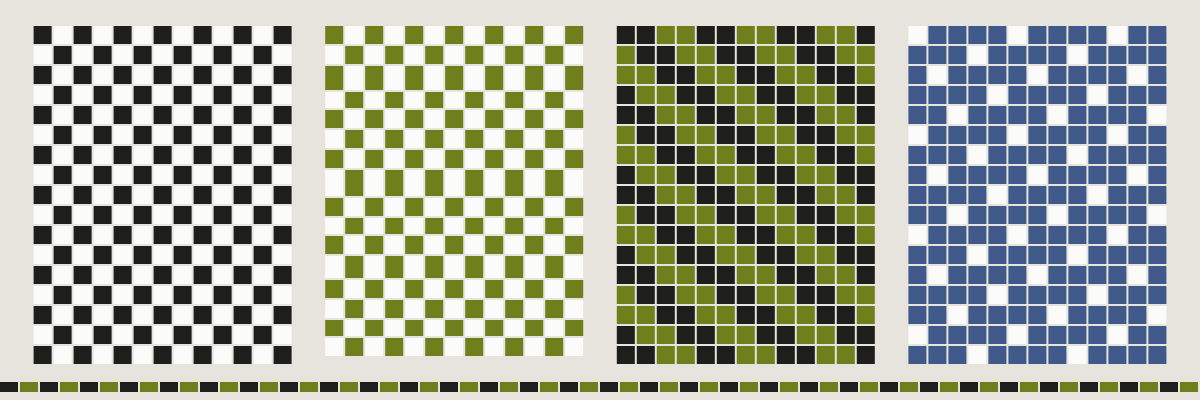
Picture two shirts side by side on the rail. The cut is the same, and so is the colour. The label of one says “100% linen”; the other’s, “100% polyester”. After a day of wear, the first has creases on the sleeves and the front, and the second looks freshly ironed. After washing, the second dries in an hour, and the first takes the whole afternoon. The difference is not in the cut or the stitching: it is inside the yarn.
This guide compares the four fibres you find most often on clothing labels: cotton, linen, wool and polyester. First, one beside the other, to understand where each one comes from and why it behaves the way it does. Then, in the situations where the choice makes a difference: hot weather, the suitcase for a trip, frequent washing, the iron.
Where each fibre comes from
The four fibres fall into two families. Three are natural: cotton and linen come from plants, and wool comes from an animal. The fourth, polyester, is synthetic: a polymer produced from petroleum derivatives and turned into yarn by extrusion.
Among the natural fibres, two pairs are worth comparing. Cotton and linen are made of the same substance, cellulose, but from different parts of the plant: cotton is the short, soft hair that surrounds the seed of the cotton plant; linen is the long, stiff fibre that runs along the stem of the flax plant. Wool, in turn, is made of protein, and each fibre is wavy and covered in tiny scales. These three differences of origin, length and surface explain almost everything that follows.
| Fibre | Origin | What it is made of | How it becomes yarn |
|---|---|---|---|
| Cotton | hairs that surround the seed of the cotton plant | cellulose | short, soft fibres, twisted together |
| Linen | fibres from the stem of the flax plant | cellulose | long, stiff fibres, separated from the stem and spun |
| Wool | fleece shorn from the sheep | protein | wavy fibres, with scales on the surface |
| Polyester | synthetic polymer, almost always PET | petroleum derivatives | continuous filament, used whole or cut into pieces |
In practice, the rail in a shop reflects world production. According to the materials market report Textile Exchange published in 2025, polyester accounted for about 59% of all the fibre produced in the world in 2024, and cotton for about 19%. Wool and other animal hair together came to less than 1%, and linen was below that. That is why most labels show polyester or cotton, pure or blended.
Moisture: how much each fibre absorbs
Fibres absorb water vapour from the air, and each one absorbs a different amount. The ASTM D1909 standard gives commercial reference values for this moisture, used in the fibre trade to calculate weight: 13.6% for wool, 8.75% for linen, 8.5% for cotton and 0.4% for polyester. The standard itself warns that these are commercial conventions, not the exact measurement of a particular fabric. They work well for comparing the order of magnitude.
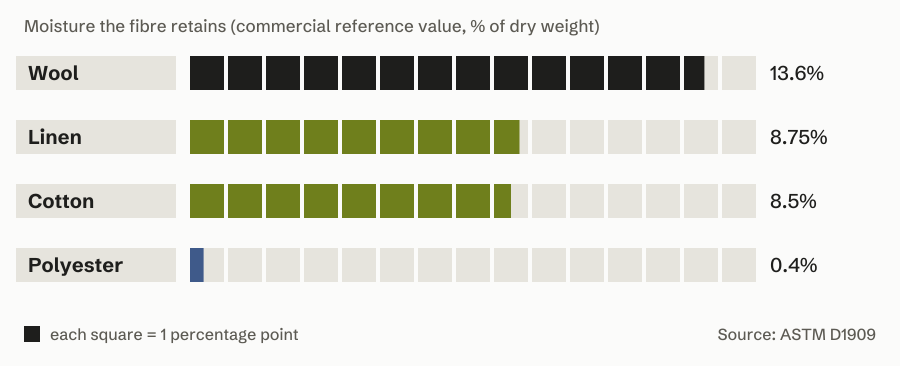
Here is what that changes, comparing two freshly washed T-shirts, one in cotton and the other in polyester. In cotton, the water enters the fibre itself, which swells and is slow to release it: the T-shirt dries slowly. In polyester, the fibre hardly absorbs water, which stays only in the spaces between the yarns and soon evaporates: the T-shirt dries quickly. The same goes for the moisture in the air over the course of the day. Cotton and linen absorb part of it, while polyester leaves it on the surface of the fabric.
Wool sits at the opposite extreme from polyester. It absorbs a lot of water vapour before it feels wet to the touch, which is why a wool coat still feels dry on a humid day. In the standard’s commercial values, linen and cotton appear almost tied; the difference between the two that is most noticeable comes further on, in creasing.
Creasing, elasticity and shape
To understand why a fabric creases, compare the two extremes: linen and wool. The linen fibre is long, stiff and hardly elastic at all. When the fabric folds, the fibre stays folded, and the crease shows sharply. The wool fibre is wavy and elastic: when the fabric folds, it returns to its previous position. That is why a wool blazer hung up overnight loses most of its creases, and a linen shirt does not.
Cotton sits halfway between them: it creases less than linen and more than wool. Polyester, in turn, keeps its shape and resists creasing. It is also the fibre that allows permanent pleats, because heat sets the fold in the yarn itself.
Another effect of wear is pilling, the small balls that appear with friction when loose fibres tangle on the surface of the fabric. They are more common in soft, loose yarns, like those of many wool knits. In polyester, because the fibre is very strong, the pills tend to stay attached to the fabric instead of falling off.
| Behaviour | Cotton | Linen | Wool | Polyester |
|---|---|---|---|---|
| Absorbs moisture | medium | medium | high | very low |
| Drying after washing | slow | slow | slow | fast |
| Creases | yes, moderately | a lot, with sharp creases | little, and the creases drop out when it hangs | very little |
| Recovers its shape after stretching | little | hardly at all | well | well |
| Iron heat (most common label) | three dots | three dots | two dots | one or two dots |
| Shrinkage | may shrink in the first washes | may shrink a little | shrinks and stiffens with heat, water and friction | hardly shrinks |
| Pilling with wear | little | rare | may appear | may appear and stay attached |
Heat and water: what changes at the iron and in the wash
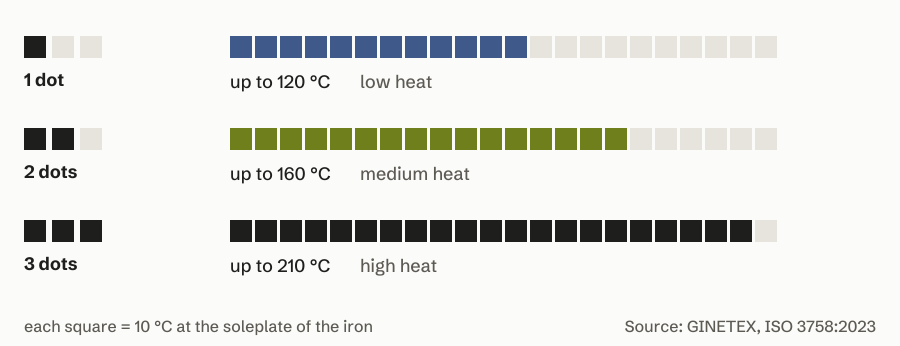
The table above shows that each fibre accepts a different amount of heat. The reason lies, once again, in the raw material. The cellulose of cotton and linen tolerates high temperatures, which is why the labels of these garments usually show the iron with three dots. Wool, being protein, needs less heat: two dots, preferably with steam. Polyester is thermoplastic, which means it softens with heat. An iron that is too hot leaves shiny marks or deforms the fabric, which is why the label usually asks for one or two dots.
Water acts differently too. Cotton and linen become even stronger when wet. Wool, by contrast, becomes more fragile when wet, and it is in wool that the best-known case of shrinkage appears: felting. The scales on the surface of the fibre work like tiny hooks. With hot water and agitation, the fibres move, the scales catch on one another and never come apart again. The sweater shrinks and becomes thicker and stiffer, and there is no way to undo it. That is why many wool garments call for a gentle wash or hand washing, unless the wool has received an anti-felting treatment, which the label or the product description usually indicates.
The weave decides too
So far, the comparison has been between fibres. But the same fibre changes its behaviour depending on how the yarns are interlaced. Cotton is an example: it appears in a dress shirt, in a pair of jeans and in a T-shirt, and the three garments behave in quite different ways.
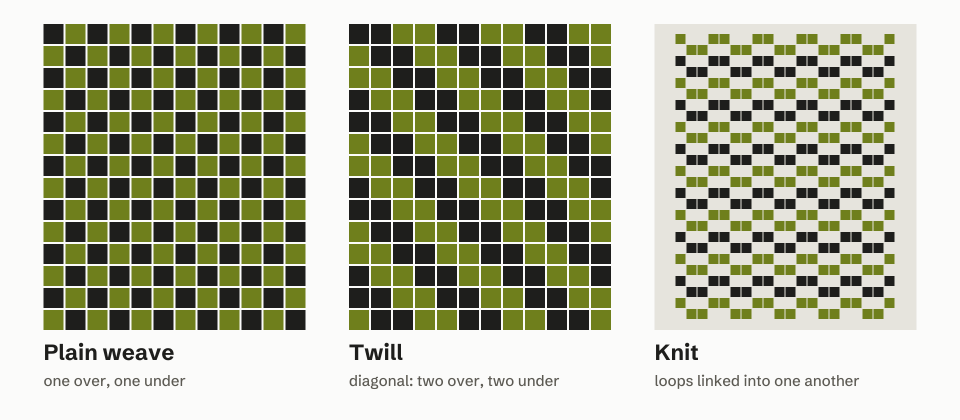
- Plain weave
- The simplest weave: one yarn over, one under. It gives firm, smooth fabrics, such as the poplin of dress shirts. It creases easily.
- Twill
- The yarns pass over two or more others and create a visible diagonal, as in denim and gabardine. The fabric drapes better and stands up to friction better than plain weave.
- Satin
- The yarns float over several others before interlacing. The surface becomes smooth and shiny, but the long yarns snag more easily.
- Knit
- There is no weave: one yarn forms loops linked into one another, as in a T-shirt and a sweater. It stretches in every direction and creases little, even in cotton.
That is why a cotton knit T-shirt and a cotton plain-weave shirt call for different care and offer different comfort, even with the same composition label. Always read the fibre and the construction together.
Blends: what the percentages say
Many labels show more than one fibre, such as “65% polyester, 35% cotton”. The blend combines behaviours: a polyester and cotton shirt creases less and dries faster than one in pure cotton, but absorbs less moisture. Wool blended with polyester or polyamide gains resistance to friction, and a small percentage of elastane is enough to give stretch to a pair of jeans or a shirt.
The fibre in the largest proportion usually sets the tone of the fabric, and the care label follows the most delicate fibre in the blend.
How to choose at the moment of purchase
With the comparisons above, each situation of use can be read as a combination of properties. The table sums up how each fibre tends to perform, always bearing in mind that the weave and the blend change the result.
| Situation | Cotton | Linen | Wool | Polyester |
|---|---|---|---|---|
| Hot days | good choice | good choice | only in light fabrics | depends on the weave |
| Cold days | in thick knits | less suitable | good choice | in layers and linings |
| Suitcase for a trip | depends on the weave | creases a lot | good choice | good choice |
| Frequent washing | good choice | good choice | needs care | good choice |
| Little time for ironing | in knit | less suitable | good choice | good choice |
In the shop or on the product page, four quick checks settle most doubts:
- Read the composition. The label lists the fibres with their percentages; in an online shop, the composition is usually in the product description.
- Identify the construction. Look at the fabric against the light: a fine check indicates plain weave, a diagonal indicates twill, and rows of loops indicate knit.
- Do the crease test. Crumple a corner of the fabric in your hand for a few seconds and let go. If the crease stays marked, the garment will crease in wear.
- Check the care symbols. The number of dots on the iron and the temperature in the wash tub tell you how much heat the garment accepts, and whether it suits your routine.
Frequently asked questions
Is creased linen a sign of poor fabric?
No. The crease comes from the fibre itself, which is stiff and not very elastic, and it appears in any pure linen. Linen fabrics blended with other fibres, or with a finish, crease less.
Is polyester always inferior to natural fibres?
No fibre is better at everything. Polyester dries quickly, creases little and keeps its shape; in return, it absorbs little moisture and does not accept high heat. The choice depends on the use the garment will have.
Why did a wool sweater shrink and become stiff?
It is felting: with hot water and agitation, the scales of the fibres catch on one another and never let go again. Wool without an anti-felting treatment calls for a gentle wash, as the label indicates.
Does every cotton garment shrink?
Many cotton fabrics shrink a little in the first washes, because the yarns stretched during manufacture relax. Pre-shrunk fabrics shrink much less; when the garment has been through this process, the label or the product description usually says so.
Sources
Consulted on 13 November 2026.
- Textile Exchange, Materials Market Report 2025: world fibre production in 2024.
- GINETEX, care symbols: iron and wash temperatures in the ISO 3758:2023 standard.
- ISO, ISO 3758:2023, Textiles — Care labelling code using symbols.
- ASTM, D1909, Standard Tables of Commercial Moisture Regains and Commercial Allowances for Textile Fibers.
- Encyclopaedia Britannica: wool, with the scales, crimp and felting of the fibre; cotton, linen and polyester.
By Inidev’s writing team
Writing, drawings and review
Inidev’s writing team writes about clothes from their fibres, weave and cut, comparing two cases side by side before drawing a conclusion. Each article relies on the sources it cites, with the date they were consulted, and is corrected and updated when a source changes or a reader points out an error.